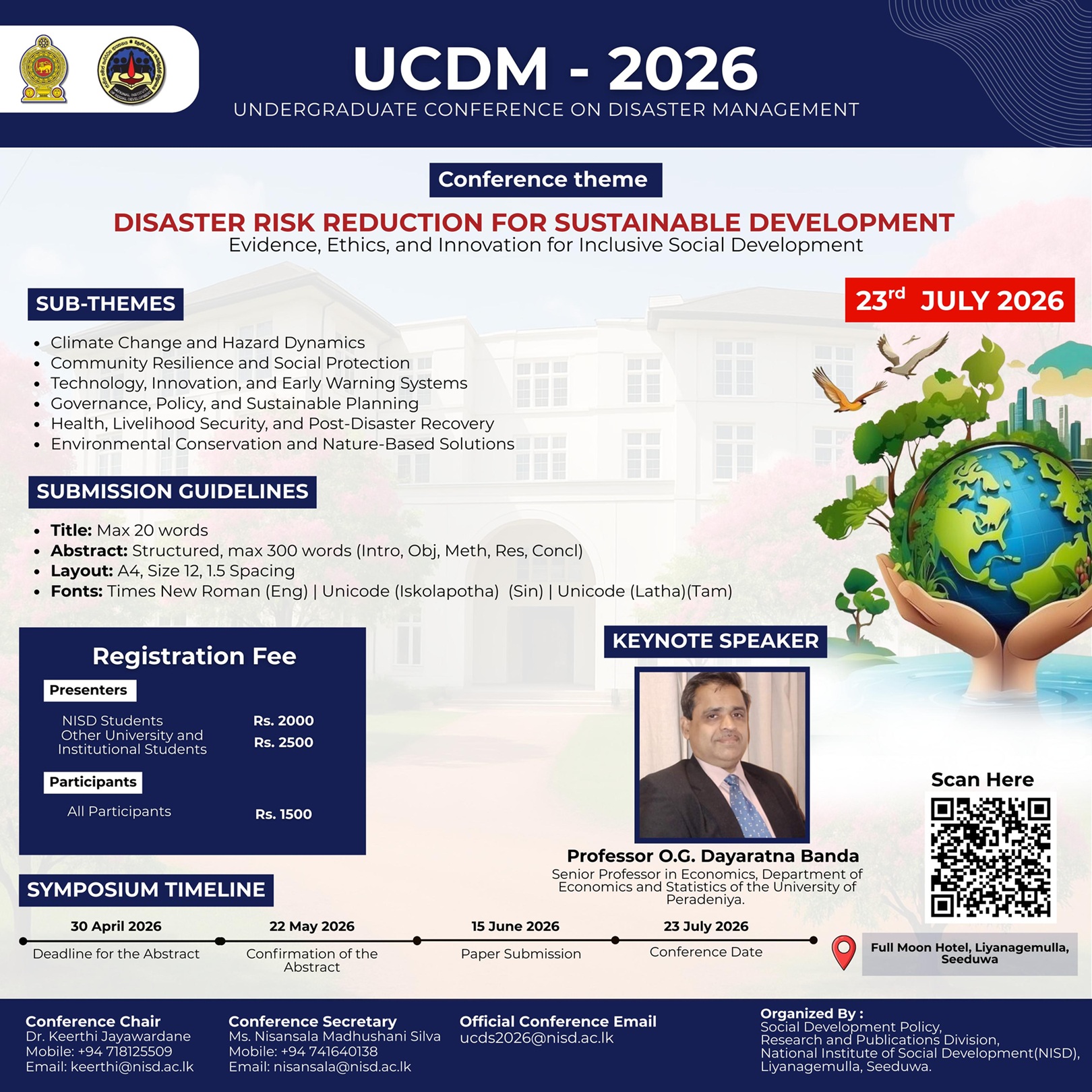
Undergraduate Conference on Disaster Management 2026
Undergraduate Conference on Disaster Management 2026
00Days
00Hours
00Minutes
00Second
Sri Lanka faces an increasing range of natural hazards, including floods, landslides, droughts, cyclones, and coastal erosion. These hazards disrupt livelihoods, undermine socio-economic stability, exacerbate poverty, and place significant long-term burdens on national development. Climate change has further intensified the frequency and severity of extreme weather events, increasing the country’s vulnerability and complicating disaster management efforts.
Disaster Risk Reduction (DRR) has therefore emerged as a critical national priority, in alignment with global frameworks such as the Sendai Framework for Disaster Risk Reduction (2015–2030), the Paris Climate Agreement, and the Sustainable Development Goals (SDGs). Effective disaster management requires strengthening institutional capacity, enhancing community resilience, promoting social equity, and integrating risk reduction strategies into broader development planning.
Empowering citizens, fostering participatory governance, and ensuring equitable access to resources and services are essential for building resilient communities and sustainable livelihoods. Engaging youth in disaster preparedness and risk management initiatives is particularly crucial, as it cultivates a generation capable of contributing innovative, evidence-based, and context-sensitive solutions.
Undergraduate students, as emerging scholars and practitioners, have a unique role in shaping research-driven, community-oriented approaches to disaster risk reduction. This conference seeks to provide an academic platform for students to present research, exchange ideas, and engage in interdisciplinary dialogue, thereby supporting national strategies for resilience and sustainable development.
Main Theme
“Disaster Risk Reduction for Sustainable Development”
Sub-Themes
Climate Change and Hazard Dynamics
Community Resilience and Social Protection
Technology, Innovation, and Early Warning Systems
Governance, Policy, and Sustainable Planning
Health, Livelihood Security, and Post-Disaster Recovery
Environmental Conservation and Nature-Based Solutions
These sub-themes ensure broad interdisciplinary participation while aligning with national disaster management priorities and the SDGs.
Keynote Speaker
Prof. O.G. Dayaratna Banda
Senior Professor in Economics, Department of Economics and Statistics of the University of Peradeniya.
Doctor of Philosophy (PhD), National University of Singapore, 2005 Master of Philosophy (Mphil), University of Peradeniya, 2000 Bachelor of Arts Special Degree in Economics,
University of Peradeniya, 1995
Deadline for the abstract
:
30th April 2026
Confirmation of the abstract
:
22th May 2026
Paper Submission
:
15th June 2026
Conference Date
:
23rd July 2026
Abstract Submission Guidelines
Title: Maximum 20 words
Abstract Length: 250–300 words
Structure: Introduction, Research Problem, Objectives, Methodology, Results and Discussion, Conclusion
Language: English
Font: Times New Roman, Size 12
Line Spacing: 1.15
Page Size: A4, 1-inch margins
Full Paper Guidelines
Word Limit: 4,000–6,000 words (including references)
Referencing Style: APA (7th edition)
Originality: Papers must not be under review elsewhere
You can present your paper online or physical (hybrid)
Submit your abstract
ucds2026@nisd.ac.lk
Registration Fees
Presenter
Nisd Students
:
Rs. 2,000/=
Other University and Institutional Students
:
Rs. 2,500/=
Participant
All participants
:
Rs. 1,500/=
Conference Advisor
Senior Prof. Premakumara de Silva (PhD, Edinburgh) Director General National Institute of Social Development